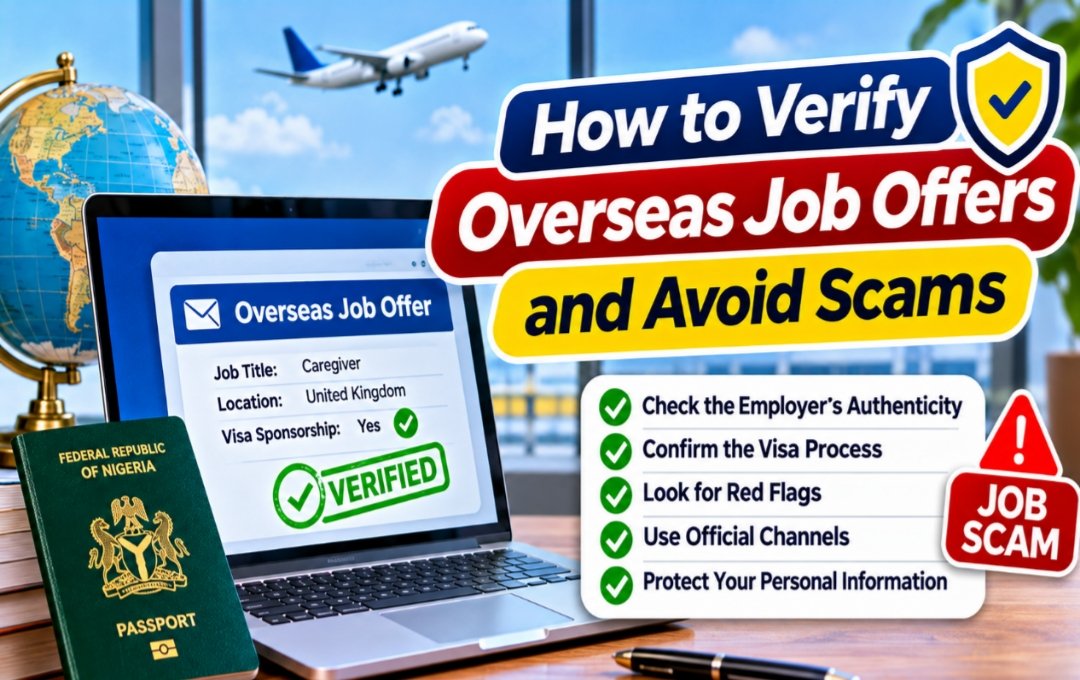
To verify an overseas job offer, check the employer through contact details you find yourself, confirm that the recruiter has the right licence for international placement, and verify the work visa process on the destination country’s official immigration website. Read the written contract before you travel, and be cautious if anyone asks you to pay for a job or promises a guaranteed visa.
Nigerians searching for work abroad may come across genuine employers, licensed agencies and convincing scams on the same platforms. A polished advert or an offer letter with a company logo is not enough to prove that a vacancy is real. Use the checks below before sending money, sharing sensitive documents or booking a flight.
1. Verify the employer independently
Start by finding the employer’s official website yourself. Do not rely only on a link, phone number or email address sent by the recruiter. Search for the company’s careers page and check whether the vacancy appears there.
If you cannot find the advert on the careers page, contact the company using details published on its official website. Ask its human resources team to confirm:
– The job title and location.
– Whether the vacancy is open.
– Whether the named recruiter or agency is authorised to recruit for the company.
– Who will employ and pay you.
– Which work visa or permit applies to the role.
You can also check the company through the relevant business registry in the destination country. This may help confirm that the business exists, but it does not prove that the job offer is genuine. A scammer can impersonate a real employer, so contact the company directly through a number or email address you found independently.
2. Check the Nigerian recruiter’s licence
If a Nigerian agency is arranging your overseas placement, ask for its full registered name and recruiter’s licence. The Federal Ministry of Labour and Employment has separate recruiter’s licence categories for domestic and international placement. An agency licensed to recruit within Nigeria should not be assumed to have permission for overseas placement. The Ministry’s [recruiters’ licence information] explains the licence categories.
You can search the [NELEX list of registered private employment agencies]as an initial check. NELEX is a Federal Ministry of Labour and Employment platform. However, appearing in a directory is not a substitute for checking the agency’s actual licence. Ask to see the licence and confirm that it covers international placement and is valid.
Check that the name and contact details on the licence match the agency and the person communicating with you. Be careful if someone sends only a screenshot of a licence or asks you to rely on a licence number without checking it independently.
The Ministry also warns that NELEX will not ask jobseekers to pay for its employment services. If a recruiter claims a payment is required, ask for a written breakdown and verify the charge with the relevant authority before paying. Rules on fees vary by country and job type. The International Labour Organization’s fair recruitment guidance says workers and jobseekers should not be charged recruitment fees or related costs. Check the rules that apply to your specific destination and placement before making any payment.
3. Confirm the job exists and the recruiter represents the employer
A real company name does not guarantee that the person contacting you works for that company. Verify both the vacancy and the recruiter.
Look up the company’s main telephone number or HR email yourself. Ask the employer to confirm that it has authorised the agency to recruit for the named role. If the recruiter says the employer cannot be contacted, or insists that all communication must stay on WhatsApp, pause the process.
Look closely at the email address and website domain. Scammers may use addresses that look similar to a company’s real domain, with an added word, extra letter or different ending. A free email account is not proof of fraud on its own, but for a high-stakes international job, ask the employer to confirm the recruiter through an official company channel.
4. Check the visa and work permit through official sources
The visa must allow you to do the work being offered. Check the destination country’s immigration authority or embassy website for the correct visa category, employer requirements, fees and application process. Do not rely on a recruiter’s explanation alone.
Ask the employer or agency for the work permit or sponsorship details relevant to that country. Then confirm what you can through the official government system. The employer’s name, your job title and the work location should be consistent across the offer, contract and visa documents.
Do not travel on a visitor or tourist visa with a plan to start working unless the destination country’s official rules expressly allow it. A recruiter’s promise that “the work visa will be changed after arrival” is not enough. You could face immigration problems, lose money or be left without a legal right to work.
Government visa fees can differ by destination and visa route. If an official fee applies, confirm the amount on a government website and use the payment method provided by the authority. Do not send money to a recruiter’s personal account for a supposed visa approval or guaranteed work permit.
5. Read the employment contract before you travel
Ask for a written contract early enough to review it. It should be in a language you understand. Make sure it clearly states:
– The employer’s full legal name and address.
– Your job title, duties and work location.
– Your salary, payment schedule and any deductions.
– Working hours, overtime rules and rest days.
– The contract period and probation terms.
– Accommodation, transport, medical cover and other benefits, if offered.
– How either side can end the contract.
– Who pays any travel or relocation costs.
Compare the contract with the offer letter and what the recruiter told you. If the salary, job title, workplace or conditions change, ask for a written explanation and contact the employer directly. Do not sign a blank document or accept a promise that you will sign the “real contract” after arrival.
Keep your own copy of every document you sign. Do not hand over your original passport to a recruiter or employer to keep. If an official process requires you to submit a passport temporarily, confirm the process with the relevant embassy, visa centre or government authority and obtain a receipt.
6. Treat requests for money as a warning sign
A request for payment does not always tell you, by itself, whether every part of a recruitment process is fraudulent. Laws and allowable costs vary. But pressure to pay an unexplained fee to secure an overseas job is a serious warning sign.
Be especially cautious if you are asked to send money for:
– A job slot, interview, shortlist or appointment letter.
– A “guaranteed” visa, work permit or sponsorship.
– A refundable security deposit.
– Processing, registration or training that is not described in a written agreement.
– A payment to a personal bank account, mobile wallet or cryptocurrency address.
The ILO’s fair recruitment principles say jobseekers should not bear recruitment fees or related costs. Before paying any legitimate-looking charge, check the destination country’s rules and confirm the amount and payment route with the relevant government authority. A genuine government fee should be verifiable through an official source. Never pay simply because the recruiter says you will lose the job if you do not transfer money immediately.
7. Watch for common overseas job scam signs
Slow down and verify the offer if you notice any of these signs:
– You receive an unsolicited job offer without applying or having a proper interview.
– The pay is unusually high for the role, while the requirements are vague.
– The recruiter promises a visa or job approval is guaranteed.
– You are told to keep the offer secret from family or officials.
– You are pressured to pay immediately or face threats that the offer will disappear.
– The company cannot be reached through its official contact details.
– The recruiter refuses to provide a written contract or licence details.
– The visa does not match the type of work you are expected to do.
– You are told to travel first and sort out your work papers later.
– The recruiter asks to keep your passport, bank card or account password.
One warning sign may not prove that an offer is fake, but several together should make you stop and investigate. Do not let excitement or a deadline prevent you from making independent checks.
8. Protect your personal documents and accounts
A recruiter may need some information to assess your application. Still, avoid sending sensitive documents before you have verified the employer and agency.
Do not share your bank PIN, password, one-time passcode or full card details during recruitment. These details are not needed to interview you. Be careful with passport scans, National Identification Numbers and other identity documents. Share them only when necessary, through a verified process, and keep a record of where you sent them.
Do not open unknown links or download files from a suspicious recruiter. A fake application form can be used to steal login details or install harmful software. If you are uncertain, type the company’s official website address into your browser instead of clicking the link in a message.